



China Best Advertising Flag Hardware Supplier?
Outdoor advertising remains visible because it meets people where they move: along sidewalks, at events, and outside retail spaces. The Out of Home Advertising Association of America reported that U.S. out-of-home advertising revenue reached a record $9.1 billion in 2023, rising 2.1% from 2022. That figure describes one national market, not global flag sales. Still, it shows why durable, adaptable display systems matter to campaign planners.
For buyers comparing a China-based supplier, Advertising Flag Hardware is more than a pole and a base. Check pole material, connector fit, base stability, fabric compatibility, and replacement-part availability. Ask for dimensions, load or wind-test details, finish specifications, and clear product photos. Small tolerances matter. A loose joint can twist a flag; an undersized base may wobble on a busy pavement. These details are worth verifying before a large order.
No single supplier is best for every project. A beach promotion, indoor exhibition, and roadside campaign place different demands on hardware. Request samples when practical, review quality-control procedures, and compare written specifications rather than relying on broad claims. Industry revenue data cannot prove one factory’s performance. That distinction matters. The strongest choice is the supplier that can document its materials, maintain consistent production, and answer technical questions clearly. Even then, field conditions vary, so test the setup where it will actually be used.
What Advertising Flag Hardware Includes and How It Works
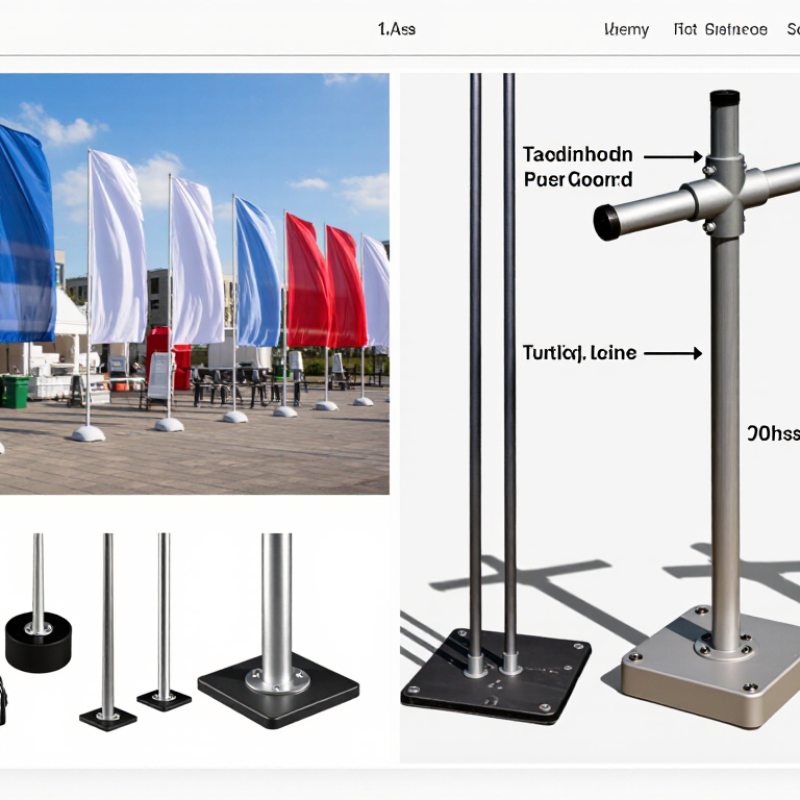
Advertising flag hardware is the support system that holds a printed flag upright and helps it move in outdoor air. Typical components include a sectional pole, a top arm or curved shaft, connectors, and a base. The base may be a cross-foot with a water bag, a ground spike, or a weighted plate. Each suits a different surface. A spike anchors into soil; a weighted plate is steadier on pavement.
How it works is simple, but details matter. The pole supports the fabric, while the top arm keeps its edge open for visibility. A swivel joint lets the assembly turn with changing wind direction, reducing fabric twist. Before use, check that the joints lock firmly and that the base matches the site. Small gaps in a connector can become obvious when the flag repeatedly snaps in a gust. Not glamorous, but important.
The Outdoor Advertising Association of America reported that U.S. out-of-home advertising revenue reached $9.1 billion in 2023, up 2.1% year over year. This industry figure does not measure flag-hardware sales, but it shows the wider value placed on visible outdoor placements. For buyers, compare pole height, packed length, connector fit, and base stability—not just the advertised setup speed. One caveat: no hardware makes every location wind-safe. Check conditions on site.
China Best Advertising Flag Hardware Supplier? - What Advertising Flag Hardware Includes and How It Works
| Hardware Component | What It Does | Common Materials | Typical Dimensions or Options | How It Works with the Flag | Selection Considerations |
|---|---|---|---|---|---|
| Flag pole sections | Support and shape the flag, forming the main upright structure. | Aluminum or fiberglass; some designs combine both. | Section lengths and assembled heights vary by flag size and design; poles commonly separate into multiple sections for transport. | Sections join together to create a flexible or partly flexible mast. The flag’s sleeve or attachment points fit over or connect to the pole. | Check assembled height, section count, joint fit, portability, and whether the pole matches a feather, teardrop, or rectangular flag pattern. |
| Top arm or curved pole section | Holds the upper edge of a flag open and helps maintain its intended shape. | Usually fiberglass or a combination of fiberglass and other pole materials. | Shape and length depend on the flag template; the arm is commonly supplied as part of the pole set. | The arm slides into the flag sleeve or connects to the upper pole section, tensioning the fabric along its top edge. | Use the correct shape and length for the flag pattern; mismatched hardware may cause poor tension or an uneven outline. |
| Ground spike | Anchors the flag pole in suitable soil or turf. | Steel or other durable metal, often with a rotating fitting at the top. | Available in different shaft lengths and diameters; the fitting must match the pole base. | The pointed end is pushed into the ground, and the pole is inserted into the upper receiver. A swivel can let the flag turn with changing wind direction. | Best suited to penetrable ground. Avoid use where underground utilities may be present, and confirm that the spike is appropriate for local ground conditions. |
| Cross base | Provides a freestanding support on firm, relatively level surfaces. | Typically steel or another rigid metal; some models fold for storage. | Footprint and pole receiver vary by model; select a base designed for the flag’s size and installation conditions. | The pole fits into a central socket. The base spreads the load across its legs, while a compatible rotating connector may allow the flag to turn. | For outdoor use, a cross base may need added weight. It is generally more suitable for sheltered conditions than an exposed, windy location. |
| Water-fillable base or weight bag | Adds ballast to help keep a compatible base stable. | Molded plastic for water-fillable bases; coated fabric for many weight bags. | Capacity varies by product. Water adds approximately 1 kg of mass per litre when filled. | A water base is filled after positioning; a weight bag is placed over or around the base and filled with sand or another suitable material. | Check the stated capacity, filling method, compatibility, and surface conditions. Drain water before freezing temperatures if the product instructions require it. |
| Rotating connector or swivel | Allows the flag and pole assembly to rotate around the base fitting. | Metal or durable molded components, depending on the design. | Connector shape and receiver size vary; compatibility is determined by the pole and base fittings. | Mounted between the pole and base, it reduces twisting of the fabric as wind direction changes. | Confirm the connector fits both adjoining parts. Rotation does not replace the need for a properly weighted and securely positioned base. |
| Flag sleeve and attachment points | Connect the printed fabric to the pole assembly. | Usually sewn fabric; reinforcement may be added at stress points. | Sleeve diameter, opening, and attachment layout depend on the pole design and flag template. | The pole or top arm passes through the sleeve, or the fabric is secured at designated points to keep it aligned. | Match the sleeve and attachment layout to the exact pole configuration; check seams and reinforced areas for repeated outdoor use. |
| Pole adapter or receiver | Connects a pole to a base or converts between compatible fitting types. | Metal or impact-resistant plastic, depending on the application. | Specified by fitting shape and dimensions rather than a universal standard; measure both mating parts before ordering. | The adapter seats in the base and provides a correctly sized socket for the pole or swivel. | Check insertion depth, internal diameter, and retention method. A loose or incorrectly sized adapter can reduce stability. |
| Carry bag | Stores and transports the disassembled pole sections and accessories. | Commonly woven synthetic fabric with a zipper or drawstring closure. | Length and compartment layout depend on the pole sections and included hardware. | Pole sections, fittings, and sometimes the folded flag are packed inside to help keep the kit together between uses. | Confirm the bag length accommodates the longest pole section and that sharp fittings are protected from fabric damage. |
Note: Dimensions, fitting styles, and load suitability vary by product design. Always verify pole-to-flag and pole-to-base compatibility, and follow the hardware maker’s installation and safety instructions.