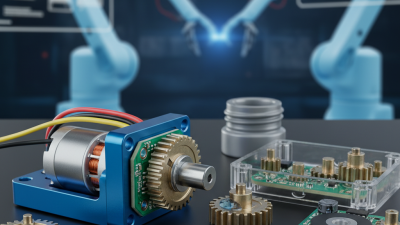
Choosing the right robot servo is crucial for your project’s success. With various options available, it can be overwhelming. The selection directly impacts performance and efficiency. Understanding your specific needs is essential.
Consider the torque requirements for your application. Different projects demand different levels of power. This can affect the servo type you need. Next, think about the size constraints. A compact robot servo may be necessary for smaller devices. Don't overlook the control method—some servos operate better with specific controllers.
It's easy to get distracted by technical specifications alone. What suits one project perfectly may not work for another. Take time to evaluate your design goals. A thoughtful approach can prevent costly mistakes later. Building a successful project requires a balance of specifications and practical use.

When choosing the right robot servo, understanding your project requirements is crucial. Start by assessing the tasks your robot must perform. Will it need high precision or swift movements? Different projects demand different features. For example, a robotic arm may need more torque for lifting, while a small drone benefits from lightweight servos.
Next, consider range and limits. Each servo has specifications like rotation angles and load capacity. Make sure these match your needs. It’s also important to evaluate the control requirements. Some servos work better with complex programming, while others use simple signals. Finding a balance between performance and ease of use can be tricky.
Reflect on your budget, too. High-quality servos can be costly. But, investing in the right components may save you time and effort later. Avoid the pitfall of buying the cheapest option just to save money. If your servo fails, you may face setbacks. Therefore, clearly defining your project requirements will enable you to make smarter decisions.
When diving into the world of robotics, selecting the right servo motor is crucial. There are several types of robot servos available, each with unique applications. Hobby servos are popular among enthusiasts. They are compact and often used in small-scale projects. These are great for controlling movement in toys or casual robots. However, they may not deliver precision for more complex tasks.
On the other hand, industrial servos excel in stability and precision. These are often used in manufacturing and automation. They handle heavy loads well. Their performance is reliable for rigorous tasks. Yet, their cost can be a hurdle for small projects. Additionally, selecting a servo involves understanding torque and speed requirements. Misjudging these can lead to project failure.
Some servos need extensive integration with controllers. This can complicate the build process, especially for beginners. It's essential to balance performance with budget. You may find that your initial choice requires modification. Be prepared to adapt based on your project's evolving demands. Each servo offers opportunities and challenges worth considering.
When selecting a robot servo, key specifications play a vital role. Torque rating is one of the most critical factors. It determines how much load a servo can handle. If you choose a servo with too little torque, it will struggle to perform. On the other hand, excessive torque can lead to inefficiencies.
Another important detail is the servo's speed. Speed indicates how quickly the servo can move to a position. For fast applications, a high-speed servo is essential. But, for precise tasks, speed may not be as critical. You might need something slower but more accurate.
Consider this carefully, or your project may not meet its objectives.
Additionally, think about the power requirements. Different servos need different voltage levels. Ensure your power source matches the servo’s needs. Over-voltage can damage the device, while under-voltage leads to underperformance. This aspect is often overlooked, but it requires thorough evaluation.
Pay attention to these specifications to enhance your project's success.
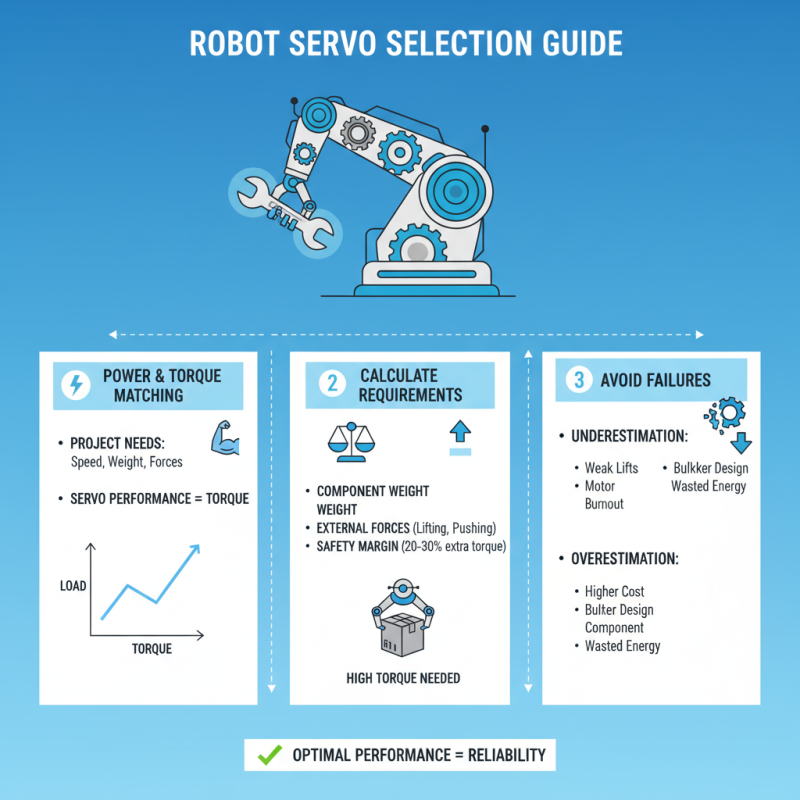
When selecting a robot servo, it is vital to match the power and torque requirements to your project's specific needs. The servo's torque directly affects its performance. Consider the weight of components and the forces at play. If your robot needs to lift heavy loads, a higher torque servo is necessary. Overestimating or underestimating these needs can lead to failures.
Tips: Assess your project's weight and force demands. Measure carefully. A miscalculation can lead to insufficient power or wasted resources.
Choosing the right power rating is equally crucial. Servos with lower power may struggle, while excessively powerful servos can consume more energy than needed. Finding the right balance is key.
Tips: Look for benchmark data on similar projects. Analyze their servo choices. This can provide insight into torque and power needs. Keep track of different responses. You may need various adjustments during the project. Trial and error can lead to improvements.
Integrating the right robot servo into your control system is crucial for enhancing performance. According to industry reports, the servo motor market is expected to grow by 5.4% annually, reaching $12 billion by 2026. This growth highlights the demand for precision and reliability in servo applications. Choosing a servo with the appropriate torque and speed specifications is essential. However, mismatching these parameters can lead to inefficiencies.
When integrating a servo, consider the control interface as well. Most servos connect through Pulse Width Modulation (PWM) signals. However, some applications may require serial communication for higher accuracy. Research reveals that 30% of projects fail due to poor interface selection. This statistic demonstrates the importance of testing different methods before finalizing your system.
It's also vital to properly assess power requirements. Many engineers underestimate the voltage needed, leading to servo underperformance. A detailed analysis can prevent potential malfunctions. Moreover, poorly selected components can contribute to project delays. Keeping these factors in mind while integrating a servo can significantly improve the outcome of any robotic project.