
How to Choose the Best Street Outdoor Light in 2026?

Choosing the best Street Outdoor Light in 2026 means balancing visibility, energy use, maintenance, and comfort—not simply buying the brightest fixture. A road should feel clear, not harsh. Drivers need to see the pavement, pedestrians, and crossing points, while nearby homes should not receive unwanted glare. The Illuminating Engineering Society’s ANSI/IES RP-8-22 provides recommended practices for roadway and street lighting, including guidance on lighting levels and uniformity. It is a useful technical reference, but local conditions still matter.

Efficiency deserves a closer look. The U.S. Department of Energy’s Energy Saver guidance reports that LEDs use at least 75% less energy and last up to 25 times longer than incandescent lighting. That comparison is not a direct forecast for replacing every streetlight; existing fixtures and operating schedules vary. Still, it highlights why buyers should compare measured luminaire efficacy, expected service life, and control options—not wattage alone. Ask for photometric files, glare-control details, color-temperature data, and a clear warranty. Small details count.

Human impact matters, too. Dr. Mariana Figueiro, a researcher in lighting and health, has described light as “the most powerful synchronizer of the circadian system.” Her work concerns light and human rhythms, not a one-size-fits-all streetlight specification. Use it as a reminder to consider timing, spectrum, and spill light alongside visibility. A good choice may cost more upfront. Sometimes the cheaper fixture is the expensive mistake. Compare real project data, and be willing to question confident claims.
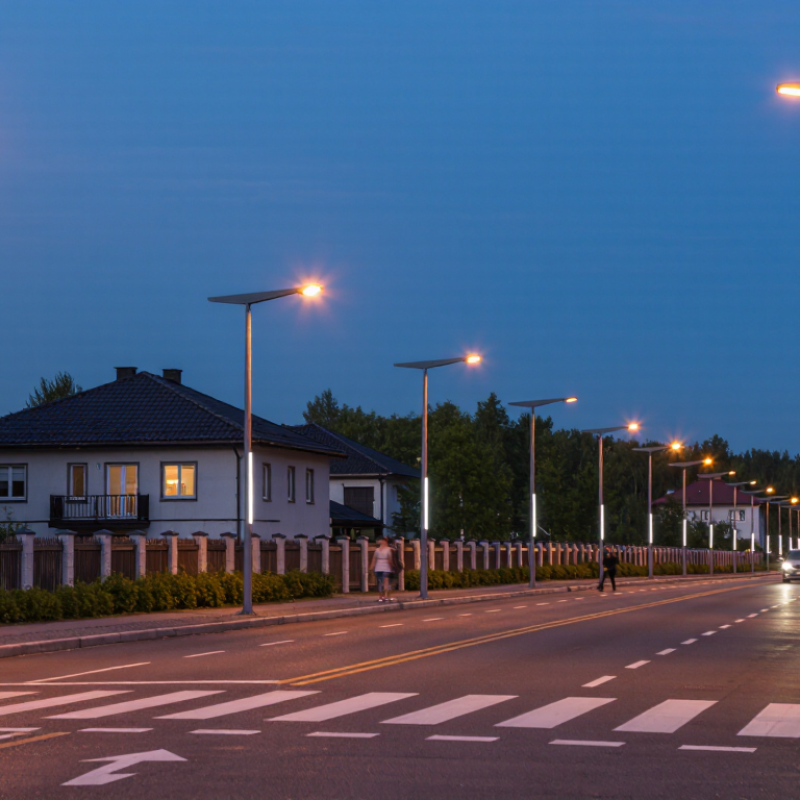
How to Choose the Best Street Outdoor Light in 2026?

Define the Lighting Needs of the Street and Surrounding Area

Define the street before selecting a fixture. A residential lane with parked cars, mature trees, and slow traffic needs a different lighting plan from a wide arterial with bus stops and turning lanes. Map crossings, driveways, sidewalks, and places where people wait. NHTSA’s Traffic Safety Facts: Pedestrians, 2022 Data reports that roughly three-quarters of pedestrian fatalities occurred in dark conditions. That is a reason to assess visibility at conflict points, not simply brighten every block.

Record road width, surface condition, traffic speed, pedestrian activity, and nearby windows or habitat. Then check the applicable lighting class and design criteria in ANSI/IES RP-8-22, Recommended Practice: Lighting Roadway and Parking Facilities. The plan should consider light levels, uniformity, glare, and spill beyond the roadway. Averages can hide dark patches. Walk the route after dark, too; wet pavement and tree canopies may change what the calculations suggest.

Tips: Photograph crossings and corners at night. Note where faces, curbs, and signs become hard to see. Include residents’ concerns about glare, but verify them on site. A tidy pole layout may still leave one awkward shadow. Recheck before finalizing.

Compare Street Light Types and Their Suitable Applications

Street-light type should match the space, not just the fixture style. For busy roads, shielded LED cobrahead luminaires direct light along lanes and reduce spill toward nearby homes. Pedestrian paths and residential streets often suit lower post-top fixtures, which create a calmer, more human-scale feel. High-mast lighting can cover broad interchanges or large parking areas, but may cause glare if poorly aimed. Solar street lights can work on remote paths where trenching is difficult; check winter sun exposure and battery capacity carefully.

The U.S. Department of Energy’s Energy Saver guidance says LEDs use at least 75% less energy and can last up to 25 times longer than incandescent lamps. That is a useful efficiency benchmark, not a direct comparison with existing high-pressure sodium streetlights. For a real project, compare measured wattage, maintained light output, color temperature, glare control, and maintenance access. A bright fixture is not automatically a better one. I would not treat any single lumen target as universal; road width, trees, and wet pavement change what people actually see.

Tips: Match optics to the road width, then inspect the site after dark. Check for dark patches near crossings and harsh light at bedroom windows. Keep a little room for adjustment.

Evaluate Brightness, Color Temperature, Optics, and Light Distribution

Choose brightness by looking at the road, not just the fixture’s lumen rating. Lumen output describes light leaving a luminaire; it does not show how much reaches the pavement. Consider lane width, mounting height, pole spacing, and pedestrian activity together. A photometric layout can estimate roadway illuminance and uniformity before installation. Check applicable local guidance, since suitable targets vary by street type.

Color temperature affects how a street feels and how details appear. A warmer white can feel less harsh in residential areas, while a neutral white may help distinguish colors and obstacles. Cooler light is not automatically brighter or safer. Compare samples outdoors if possible. Small differences matter. I would avoid choosing by a catalog image alone; screens rarely show nighttime color accurately.

Optics determine where light goes. A distribution suited to a narrow street may leave dark gaps on a broad road, while poorly controlled light can spill into windows or the sky. Review the fixture’s photometric data and check coverage between poles, at sidewalks, and near intersections. Look for comfortable uniformity, not just bright spots beneath each pole. Test it at night. A field check may reveal a mismatch the plan missed, and that is worth correcting before the layout is repeated across a whole street.

Check Energy Use, Durability, Controls, and Safety Certifications

How to Choose the Best Street Outdoor Light in 2026?

Compare energy use before judging brightness. The U.S. Department of Energy’s 2017 report on LED street-light adoption found that LED systems can use at least 50% less energy than conventional street lighting. Actual savings depend on fixture design, operating hours, and dimming settings. Ask for wattage and a clear photometric plan, not just a bright-looking sample. Small details matter.

For durability, check the fixture’s IP rating, impact resistance, corrosion protection, and stated operating temperatures. A sealed housing helps keep rain and dust away from electrical parts, but seals can age. Controls such as photocells, timers, and adaptive dimming can reduce unnecessary operation. The International Energy Agency’s Energy Efficiency 2023 report identifies efficient lighting as an important source of electricity savings. Yet complicated controls can be poorly configured. I’d ask who will set them up and maintain them.

Check that the complete luminaire—not only its components—has safety documentation from a recognized testing body. For road and street fixtures, confirm relevant requirements such as IEC 60598-2-3 apply in your market. Request test reports, installation instructions, and warranty terms before purchase. I admit, certification paperwork is easy to skim. Don’t. A low price means little if the fixture overheats, fails early, or creates uneven glare on wet pavement.

Compare Total Costs, Installation Requirements, and Long-Term Maintenance

A street light’s purchase price is only one part of its cost. Compare the full installed price, including the fixture, pole, foundation, wiring, controls, equipment rental, and labor. Ask whether the quote includes permits, trenching, and traffic management. Those items can change the budget quickly. A low-cost unit may also use more electricity or need earlier replacement, so compare expected energy use and service life.

Installation depends on the site. Check pole height, ground conditions, nearby trees, existing conduit, and access for a lift before choosing a light. Reusing sound wiring may reduce work, but an electrician should verify its condition and capacity. For solar models, note winter shade and the hours of usable light required; a sunny afternoon is not the whole story. Small details matter. Leave room for realistic installation delays, too.

Long-term maintenance affects both cost and safety. Review how easily crews can reach the fixture, replace its driver or battery, and clean the lens. Ask for clear warranty terms and replacement-part availability, not just a long headline lifespan. A simple spreadsheet can compare purchase, installation, energy, and expected maintenance costs over several years. Estimates are never perfect; local labor rates and weather can shift them. Still, a careful comparison is better than choosing by sticker price alone.

SERVO-ROBOT Inc
Privacy Overview

This website uses cookies so that we can provide you with the best user experience possible. Cookie information is stored in your browser and performs functions such as recognising you when you return to our website and helping our team to understand which sections of the website you find most interesting and useful.