Top 10 Intelligent Robot Manufacturers for Global Buyers

An intelligent robot can reshape a production line, warehouse, or inspection process, but the right choice depends on the work. A robot moving small parts between fixtures has different needs from a mobile system navigating a busy warehouse. Buyers should compare payload, reach, repeatability, cycle time, and operating environment. They should also check how easily the robot connects with existing controls, grippers, sensors, and safety equipment.

This guide introduces ten manufacturers for global buyers and explains the capabilities that may matter in different applications. It considers product range, automation experience, integration support, documentation, and access to service and replacement parts. These details can affect daily operations as much as the robot’s specifications. Ask for application-specific demonstrations and clear information about installation, training, maintenance, and local support. A polished demo is useful, but it cannot prove performance on your factory floor.

No shortlist is perfectly neutral. Manufacturer portfolios change, and a strong brand may not suit every budget, facility, or production volume. Even published specifications need context: payload can vary with reach, tooling, and motion speed. Treat this overview as a starting point, not a substitute for technical review. Match each candidate to a real task, then confirm requirements with the manufacturer or a qualified integrator before making a purchase.
Top 10 Intelligent Robot Manufacturers for Global Buyers

What Defines an Intelligent Robot Manufacturer in the Global Market?

What Defines an Intelligent Robot Manufacturer in the Global Market?

In the global market, an intelligent robot manufacturer does more than assemble arms, sensors, and controllers. It combines dependable hardware with perception, motion planning, data security, and practical installation and maintenance support. The International Federation of Robotics (IFR) reported 541,302 industrial robot installations worldwide in 2023, with the operating stock reaching 4.28 million units (World Robotics 2024). At this scale, reliability needs measurable proof. Buyers should ask how uptime is defined, how quickly service teams respond, and whether spare parts are available. A polished demonstration is not proof.

Intelligence also depends on integration. A robot should interpret changing inputs, recover safely from faults, and exchange data with existing production systems. IFR reported global robot density of 162 units per 10,000 manufacturing employees in 2023. That signals broad adoption, but does not prove every deployment delivers value. Ask for task-level trials, cycle-time records, and operator training plans. Claims of “autonomy” deserve careful scrutiny; edge cases are often where impressive systems stumble. That is worth testing.

Tips: Test your own parts under real lighting and shift conditions. Request documented failure rates and update procedures. Compare lifecycle costs, not only purchase price.

Key Robot Types, Technologies, and Industrial Applications

Intelligent robots are not one machine category. Articulated arms handle welding and palletizing, while SCARA robots suit fast, precise assembly. Collaborative arms can share selected tasks with workers, and autonomous mobile robots move bins through warehouses. Fit matters. Reach, payload, cycle time, and safe stopping distance all affect whether a system works on a real production floor.

Technology makes these robots more adaptable. Cameras identify parts; force sensors detect contact; AI can help classify objects or adjust paths. Yet a polished demonstration may hide difficulties: reflective metal, changing light, or a misplaced component can disrupt perception. Integration with conveyors, safety controls, and factory software also takes careful testing. More intelligence does not automatically mean less maintenance.

The International Federation of Robotics’ World Robotics 2024 report recorded 541,302 industrial robot installations worldwide in 2023. Its World Robotics 2024 service-robot report counted nearly 113,000 professional robots sold for transportation and logistics that year. These figures show why factories and distribution centers are major application areas. In practice, manufacturers should compare uptime, changeover time, and service access—not just advertised speed. Some tasks still resist automation, and that deserves an honest assessment.

How Global Buyers Can Evaluate Manufacturers and Their Solutions

Global buyers should compare intelligent robot manufacturers by the work their systems can reliably perform, not by feature lists alone. The International Federation of Robotics’ World Robotics 2024 report records 541,302 industrial robots installed worldwide in 2023. The global operational stock reached about 4.28 million. These figures show the scale of deployment, but they do not prove that a particular robot suits your factory. Numbers need context.

Ask manufacturers to demonstrate your actual task, using representative materials, cycle times, and workspace conditions. Match payload, reach, repeatability, and end-of-arm tooling to the job. Check software compatibility, safety documentation, commissioning support, spare-parts access, and operator training. A polished video is not a factory acceptance test. Request references for similar applications, then clarify what performance data those references can share. If an on-site trial is unavailable, a detailed simulation may help, but it leaves some uncertainty.

Tips: Bring sample parts and a written task sequence to technical discussions. Fit matters more. Record response times, integration assumptions, and service commitments in writing; small gaps here can become costly delays later.

Top 10 Intelligent Robot Manufacturers for Global Buyers

How Global Buyers Can Evaluate Manufacturers and Their Solutions

Use these illustrative weights as a starting point, not as survey results or a manufacturer ranking. Assess application fit, safety and compliance, integration, service and reliability, total cost of ownership, and cybersecurity against your project requirements. Verify each capability with documentation, demonstrations, and references.

Top 10 Intelligent Robot Manufacturers and Their Distinctive Strengths

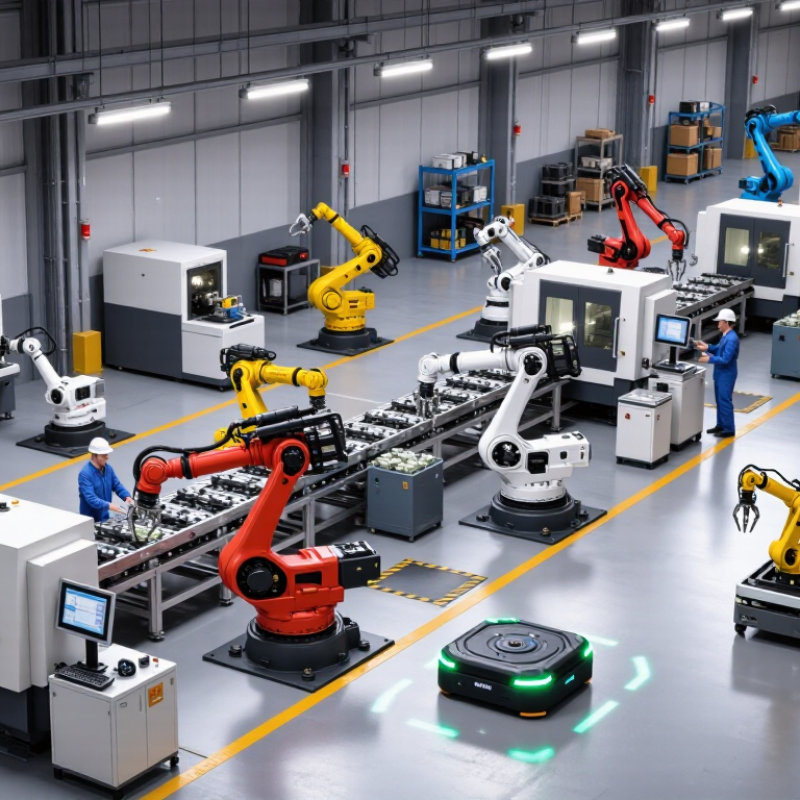
The strongest intelligent robot manufacturers are not interchangeable. One may excel at high-payload arms for moving heavy components. Another may build compact collaborative robots for crowded assembly cells. A third may focus on mobile robots that carry bins across busy factory floors. Vision-focused makers help robots locate misaligned parts, while sensor specialists improve handling of delicate objects. Some manufacturers stand out for easy-to-program software. Others offer flexible grippers, detailed safety controls, or smooth integration with existing production lines. A tenth may differentiate itself through responsive service and readily available replacement parts. Small details matter: a gripper that releases a warm metal fitting reliably can save more time than an impressive demonstration.

For global buyers, compare each manufacturer against the actual task, not just a product brochure. Check payload, reach, cycle time, installation needs, and performance under changing lighting or dusty conditions. Ask for a trial using your own parts. No system is perfect. Software updates can disrupt familiar workflows, and quoted cycle times may not reflect real shifts. A candid supplier will explain limitations, training requirements, and maintenance intervals. Also review local support coverage and spare-part lead times before choosing. The best match is the one that performs consistently on your line, with clear evidence and realistic service commitments.

Top 10 Intelligent Robot Manufacturers for Global Buyers - Top 10 Intelligent Robot Manufacturers and Their Distinctive Strengths

An anonymized, illustrative global shortlist organized by manufacturing region and publicly established product focus. Profiles are not ranked by revenue or market share; verify current specifications, service coverage, and certifications directly with suppliers.

Profile Manufacturing Region Common Robot Portfolio Distinctive Strength Typical Buyer Fit
Profile 01 Japan Articulated industrial robots for welding, painting, handling, and assembly Broad application coverage and mature automation experience in high-volume production Automotive plants and manufacturers seeking established industrial robot workflows
Profile 02 Japan Industrial robots alongside CNC and factory automation equipment Close integration between robots, machine tools, and production control systems Factories automating machine tending, loading, and repeatable machining operations
Profile 03 Switzerland Articulated robots for material handling, assembly, and process automation Strong presence in precision-focused industrial automation and integrated cell solutions Electronics, automotive, and general manufacturers with demanding process requirements
Profile 04 Denmark Collaborative robots designed to work near people in suitable applications Emphasis on accessible programming and flexible deployment for smaller work cells Small and midsize manufacturers introducing automation incrementally
Profile 05 Germany Industrial and collaborative robots for assembly, handling, and production processes Extensive industrial automation expertise and a broad application ecosystem Manufacturers seeking integration with established production and engineering systems
Profile 06 China Articulated, SCARA, and other industrial robot types Broad domestic supplier ecosystem and strong availability across common factory applications Buyers prioritizing local service access and a wide range of automation options
Profile 07 South Korea Industrial robots used in automotive, electronics, and factory automation Established expertise in high-volume manufacturing environments Electronics and automotive suppliers with repetitive production tasks
Profile 08 United States Autonomous mobile robots and warehouse automation systems Focus on autonomous navigation, fleet coordination, and material movement Warehouses and factories seeking to automate internal transport
Profile 09 Italy Industrial robots for welding, handling, foundry work, and palletizing Experience serving diverse manufacturing processes, including demanding production environments Metalworking, packaging, and general manufacturers automating production cells
Profile 10 Taiwan Industrial and compact robots used in electronics and precision manufacturing Strong regional manufacturing ecosystem for electronics and factory automation Electronics, component, and machinery manufacturers seeking regional support options

International Sourcing, Integration, and After-Sales Support Considerations

Global buyers should assess robot manufacturers beyond payload and cycle time. The International Federation of Robotics reported 541,302 industrial robot installations worldwide in 2023. That scale makes cross-border service capacity a practical purchasing concern. Ask who handles commissioning, spare parts, software updates, and operator training in your region. Get response times and parts availability in writing. Test it onsite.

Integration quality often determines whether a robot works reliably on a real production line. Request a site assessment covering floor space, safety zones, network access, and existing equipment. A 2024 Deloitte survey found that 86% of surveyed manufacturing executives viewed smart manufacturing as a key competitiveness driver over the next five years. But readiness varies between sites. Confirm interfaces and acceptance tests before shipment, then run a pilot using actual products and shift patterns. A demo cell may not reveal bottlenecks at peak throughput.

After-sales support deserves the same scrutiny as the initial quote. Check whether technicians can diagnose faults remotely and arrive onsite when needed. Ask for training materials in the working language and a clear escalation path. Keep critical spares near the facility. This sounds basic, yet it is often missed. One weakness in many sourcing plans is assuming promised response times will hold during regional holidays or parts shortages; verify them with a service-level agreement and a named local contact.

SERVO-ROBOT Inc
Privacy Overview

This website uses cookies so that we can provide you with the best user experience possible. Cookie information is stored in your browser and performs functions such as recognising you when you return to our website and helping our team to understand which sections of the website you find most interesting and useful.