Robotic plasma cutting is changing how manufacturers handle repetitive steel fabrication, from large structural frames to smaller agricultural components. Yet buying a system across borders involves more than comparing torch speed and advertised power. A machine that performs well in a showroom may struggle with dusty floors, unstable air pressure, or unfamiliar software. Real production conditions matter.
This guide presents seven practical tips for global buyers evaluating robotic plasma cutting equipment. It examines cutting capacity, robot reach, torch-height control, consumable costs, fume extraction, operator training, and after-sales support. Details such as a 6-millimeter steel plate, a worn electrode, or a delayed replacement cable can strongly affect daily output. Small parts matter.
Experienced integrators usually test sample drawings before recommending a configuration. Buyers should request cutting trials, maintenance records, electrical specifications, and clear warranty terms. Local certification and workplace-safety requirements also need verification with qualified professionals. Requirements differ by country and application.
A low purchase price can hide expensive downtime. No machine is perfect. Even a well-built cell may need better fixturing or slower settings for warped plate. This article therefore avoids one-size-fits-all promises. It encourages practical questions, documented testing, and honest comparison. Reliable automation comes from matching the system to real materials, real operators, and real production goals.
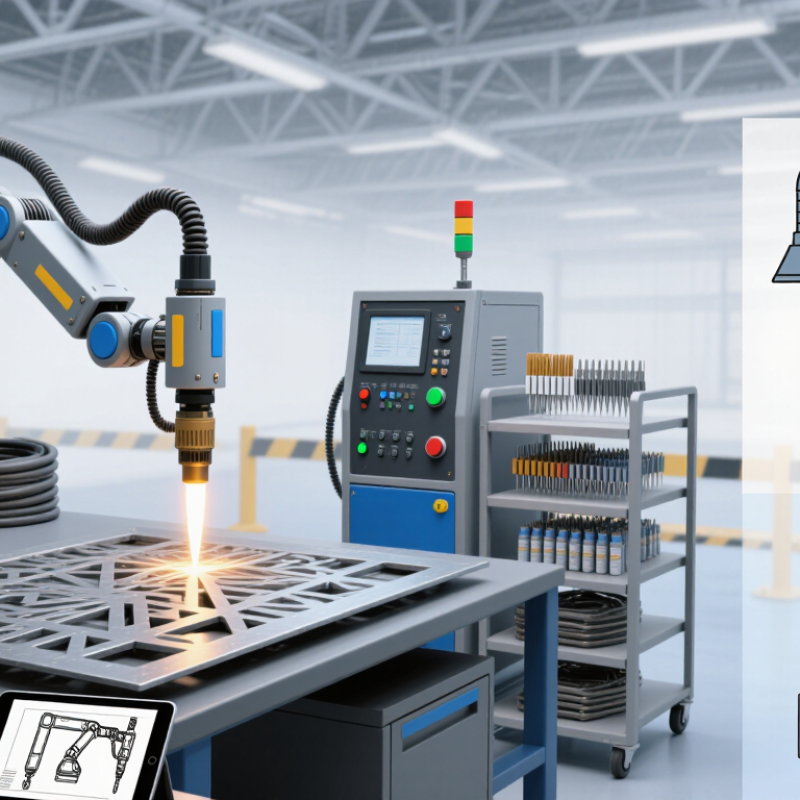
Choosing plasma power starts with the steel, not the robot. For 1–3 mm sheet, 30–45 A can provide cleaner edges and lower heat input. Medium plate, around 6–12 mm, often needs 60–85 A for stable production cutting. Steel near 20–25 mm may require 100–125 A, depending on speed, gas, and edge-quality targets. These ranges are practical guides, not guarantees.
The International Federation of Robotics reported 541,302 industrial robot installations worldwide in 2023. That growth increases demand for repeatable cutting cells. However, a robotic arm cannot correct poor process selection. Measure actual thickness, confirm material grade, and define the required cut classification under ISO 9013. Then test sample coupons before approving a production program. Small details matter.
Use the rated cutting capacity carefully. Maximum severance is not the same as a reliable production cut. I would not promise 25 mm steel at every setting. Torch height, consumable wear, compressed-air moisture, and table vibration can change the result. Keep a power margin when possible. It reduces stalled cuts and excessive dross. Still, higher amperage is not automatically better. Thin sheet may warp, and the kerf can widen. Review trial results with operators, maintenance staff, and quality engineers before final purchase.
A six-axis robot can approach complex plate contours from multiple angles. However, longer reach does not automatically improve cutting quality. Buyers should map the torch center point, cable bend radius, fixture height, and required stand-off distance before selecting the arm. A useful factory test places sample plates at the farthest corners of the work envelope. Watch for wrist joints nearing their limits.
Payload calculations must include the torch, mounting bracket, hose package, collision sensor, and cable drag. A 10-kilogram torch package may create greater wrist stress when extended than its static weight suggests. Six-axis flexibility also introduces singularities, where small path changes cause sudden joint movement. That detail is easy to miss.
The International Federation of Robotics reported 541,302 industrial robot installations worldwide in 2023, with more than 4.28 million robots operating globally. This expanding installed base makes integration experience increasingly important for international buyers. Request reach diagrams, payload curves, repeatability data, and cycle-time tests using your actual material thickness. Do not rely only on catalog figures.
In my experience, cable routing often becomes the weak point. It can restrict wrist rotation, accelerate wear, or disturb torch alignment. Engineers should test awkward corners, tilted fixtures, and emergency stops before approval. The first simulation may look perfect. Physical trials can disagree. That is useful evidence, not failure.
Verify cut quality against ISO 9013:2017, not appearance alone. The standard classifies thermal-cut edges by angularity, tolerance, and surface roughness. Request samples showing the specified ISO 9013 quality range. Examine a 10 mm plate under consistent lighting. Look for dross, bevel variation, drag lines, and heat-affected distortion.
Set a measurable positioning target. A practical acceptance goal is ±0.5 mm at defined reference points, but this is not a universal guarantee. Confirm whether the value covers robot repeatability, torch alignment, plate movement, and cutting compensation. ISO 230-2 provides a recognized approach for evaluating machine-tool positioning accuracy and repeatability. Use calibrated gauges or a coordinate measuring system. Record results across several locations, not one convenient corner.
The International Federation of Robotics reported 541,302 industrial robot installations worldwide in 2023. More automation makes verification more important, not less. Ask suppliers for cutting speed, material thickness, gas settings, and inspection records. Repeat the test after continuous operation, because thermal drift can change the result. A target can look impressive on paper. It may fail in production. Also check whether ±0.5 mm means absolute accuracy or repeatability; suppliers sometimes present these terms too casually.
For global buyers, compliance should be checked before comparing cutting speed or table size. ISO 10218 covers robot safety, including guarding, stop functions, teaching modes, and operating limits. Ask for the risk assessment, not only a declaration. Confirm interlocked doors, visible emergency stops, and controlled restart behavior. A fast torch is useless if an opened door does not stop motion.
ISO 13849 focuses on safety-related control systems. Request the achieved Performance Level, validation records, and fault-response test results. Check whether safety circuits cover the robot, plasma source, extraction unit, and positioner. Cable damage, a failed relay, or a welded contact should produce a defined safe state. Test these functions during a witnessed acceptance inspection. Paperwork can look complete while wiring remains unclear.
IEC 60974-10 addresses electromagnetic compatibility for arc welding equipment. Ask for test reports matching the supplied plasma equipment and its configuration. Inspect grounding, cable separation, shielding, and controller behavior during ignition. Verify local installation rules and language requirements. Standards evolve, and older reports may not fit current editions. Leave room for doubt. An independent safety review often finds small gaps before shipment, although buyers sometimes treat it as an unnecessary cost. That mistake can delay commissioning and create expensive rework.
Check safety compliance with ISO 10218, ISO 13849, and IEC 60974-10 before purchasing or commissioning a robotic plasma cutting system.
The chart compares the publication years of key international standards commonly considered when evaluating robotic plasma cutting equipment. ISO 10218 addresses robot safety, ISO 13849 addresses safety-related control systems, and IEC 60974-10 addresses electromagnetic compatibility requirements for arc welding equipment. Buyers should verify the applicable edition, risk assessment, validation records, and local regulatory requirements with the supplier.
Global buyers should compare more than the purchase price of a robotic plasma cutting cell. A 60% duty cycle means six minutes of cutting within every ten-minute period. It does not guarantee 60% productive output. Loading delays, plate alignment, piercing, and torch changes reduce real utilization. Test the cell with your actual steel thicknesses and nesting patterns.
Consumables can quietly reshape ownership costs. Track electrode, nozzle, shield cap, gas, and torch-height sensor usage per finished meter. A 2024 industry cost study from the Fabricators and Manufacturers Association reported that labor, overhead, and material handling remain major manufacturing cost drivers. Automation may reduce direct labor, but maintenance and programming still require skilled workers. That gap matters. Compare landed price, freight, import duties, installation, training, software updates, energy, and spare parts over five years.
The International Federation of Robotics reported 541,302 industrial robot installations worldwide in 2023, showing wider acceptance of automation. However, adoption does not equal fast payback. Use this formula: annual savings divided by total installed cost. Include realistic uptime, not the supplier’s best-case figure. A one-hour daily delay can erase projected ROI. I would also question optimistic consumable estimates. Keep a monthly log of arc-on time, pierce count, scrap, and replacement costs. Small records often expose large assumptions. A controlled production trial is worth more than a polished spreadsheet.
| # | Buying Tip | Benchmark or Calculation | North America | European Union | Southeast Asia | Latin America |
|---|---|---|---|---|---|---|
| 1 | Verify the 60% duty cycle | A 60% duty cycle allows approximately 36 minutes of arc-on time in each 60-minute period. At 2,080 scheduled hours per year, the theoretical maximum is about 1,248 arc-on hours. | 1,248 h/year Typical practical use: 730–940 h |
1,248 h/year Typical practical use: 730–940 h |
| 2 | Compare landed cost, not purchase price | Assumes a robotic plasma cell purchase price of US$120,000, international freight and insurance of US$8,000, plus regional import duty applied to the equipment value. | US$128,000 0% duty assumption |
US$133,000 4% duty assumption |
US$135,200 6% duty assumption |
US$140,000 10% duty assumption |
| 3 | Budget consumables by arc-on hour | Planning allowance: US$9 per arc-on hour for electrodes, nozzles, shields and routine torch components. At 1,248 arc-on hours, annual consumables are estimated at US$11,232. | US$11,232/year | US$11,906/year 6% logistics allowance |
US$11,794/year 5% logistics allowance |
US$12,355/year 10% logistics allowance |
| 4 | Include power, gas and extraction costs | Estimated auxiliary and plasma-system demand of 30 kW during arc-on time. Annual energy use is approximately 37,440 kWh before standby losses and non-cutting time. | US$4,493/year US$0.12/kWh |
US$8,237/year US$0.22/kWh |
US$3,370/year US$0.09/kWh |
US$5,242/year US$0.14/kWh |
| 5 | Measure labor savings realistically | Assumes one operator oversees the cell while manual cutting and handling require 2.5 labor-equivalents. The estimated annual gross labor saving is based on 1.5 avoided labor-equivalents. | US$78,000/year US$52,000 per labor-equivalent |
US$67,500/year US$45,000 per labor-equivalent |
US$36,000/year US$24,000 per labor-equivalent |
US$45,000/year US$30,000 per labor-equivalent |
| 6 | Reserve maintenance and spare-parts funds | Use 8% of the initial cell investment as an annual allowance for preventive maintenance, calibration, torch repairs, robot servicing, software support and unexpected downtime. | US$10,240/year | US$10,640/year | US$10,816/year | US$11,200/year |
| 7 | Calculate payback and five-year ROI | Five-year TCO includes landed equipment, installation and training of US$22,000, five years of consumables, energy and maintenance. Payback equals initial investment divided by annual net operating benefit. |
5-year TCO: US$295,815 Payback: 2.7 years Five-year net ROI: 32% |
5-year TCO: US$330,915 Payback: 3.5 years Five-year net ROI: 14% |
5-year TCO: US$254,100 Payback: 4.8 years Five-year net ROI: 2% |
5-year TCO: US$302,985 Payback: 4.0 years Five-year net ROI: 8% |