7 Tips to Choose the Best Oilless Air Compressor
Choosing the right Oilless Air Compressor is not simply about comparing horsepower or price. The best model must match your tools, workspace, duty cycle, and maintenance expectations. A quiet compressor may suit a dental clinic, while a higher-flow unit may serve a busy workshop. The wrong choice can cause pressure drops, overheating, or frustrating delays. Small details matter.
This guide presents seven practical tips for making a more reliable decision. It examines airflow, tank capacity, noise levels, energy use, portability, filtration, and long-term service support. These factors reflect common engineering guidance and real workplace concerns. Check the manufacturer’s specifications carefully. Do not trust attractive marketing alone. I have seen buyers focus on peak pressure and overlook usable airflow, which created problems during continuous operation. That mistake is easy to repeat. An honest evaluation should also consider local voltage, ventilation, replacement parts, and expected running hours. Some oil-free designs are cleaner, but their components may wear faster in demanding environments. That trade-off deserves attention. Take your time. The goal is not the biggest compressor. It is the most dependable fit for your application, budget, and working conditions.
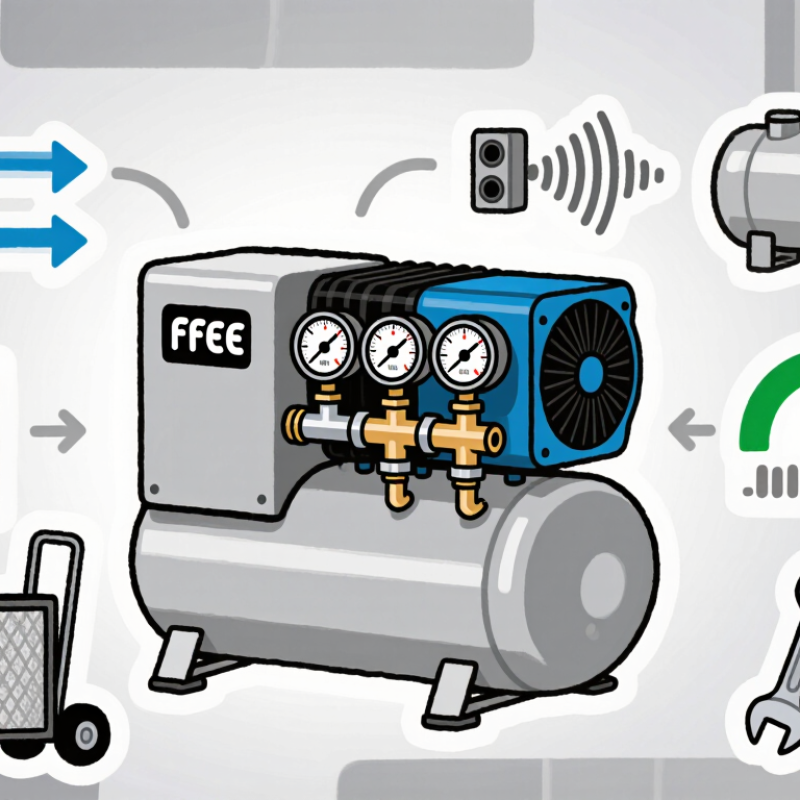
Define Your Air Requirements Before Comparing Compressors
Before comparing oilless air compressors, define the air your process actually needs. Record pressure, flow, duty cycle, and operating hours. A workshop using air tools may need intermittent flow, while packaging equipment may require stable, continuous delivery. Check the highest-pressure device, not the average one. Oversizing creates unnecessary energy costs.
Tip 1: Measure demand in actual operating conditions. The U.S. Department of Energy’s Improving Compressed Air System Performance sourcebook notes that compressed air can represent about 10% of industrial electricity use. It also highlights leakage as a major source of waste. Your estimate may be wrong if leaks remain untested. A simple ultrasonic survey can reveal hissing around fittings, hoses, and valves.
Tip 2: Specify air quality before reviewing specifications. ISO 8573-1 classifies compressed-air contamination by particles, water, and oil. Medical, laboratory, and food-related processes may require tighter limits than general workshop tools. “Oilless” does not automatically mean contamination-free. Confirm the required purity class, outlet filtration, dew point, and validation method. Tip 3: Compare flow at the required pressure, not the advertised maximum. Review FAD or equivalent test data, sound levels, heat discharge, and maintenance intervals. The European Commission’s Energy Efficiency Best Practice guidelines identify compressed-air systems as significant industrial energy users. A smaller compressor with poor duty matching can cost more over time. I would also allow capacity for future demand, but not an optimistic expansion plan.
Check Oil-Free Technology and Air Purity Standards
Choosing the best oilless air compressor starts with air purity, not the “oil-free” label. ISO 8573-1:2010 classifies compressed air by particles, water, and oil. Class 0 is the strictest category, but it does not mean zero contamination. It means the user defines the lowest practical limits. Check the required class before comparing machines. Check the compressor technology, test method, and certificate validity. Ask for independent laboratory results, not only brochure claims.
Check the dryer’s pressure dew point. Moisture can damage instruments and encourage corrosion inside a clean-looking pipe. Check inlet filters and their replacement intervals. Check the receiver and distribution piping, especially dead legs near production points. The U.S. Department of Energy’s compressed-air sourcebook reports that leaks can waste 20% to 30% of compressor output. That waste also changes pressure stability. A smaller compressor may look efficient, then struggle during peak demand.
Check air quality at the point of use. ISO 8573-1 compliance at the compressor outlet may not represent the final workstation. Sample during normal production, after maintenance, and during humid weather. For pharmaceutical, medical, or food processes, align the specification with documented risk assessment and validation requirements. A clean commissioning report can mislead. I would also review energy data, service access, and alarm history for at least several months. Perfect assumptions rarely survive real dust, heat, and rushed maintenance.
Compare Capacity, Pressure, and Energy Efficiency
7 Tips to Choose the Best Oilless Air Compressor
Compare capacity at your actual working pressure, not the largest number on a brochure. The U.S. Department of Energy reports that compressed-air leaks commonly waste 20–30% of compressor output. A small receiver, oversized piping, or frequent pressure drops can make a low-priced unit expensive. Check free air delivery, tank volume, duty cycle, and recovery time. A workshop using two pneumatic tools may need stable flow, not simply a bigger motor. Keep a margin, but avoid excessive capacity.
Pressure ratings also need careful reading. ISO 1217 testing supports more reliable compressor performance comparisons, while ISO 8573-1 helps define compressed-air cleanliness. Ask whether the stated flow is measured at your required pressure.
Energy efficiency deserves equal attention. DOE guidance identifies compressed air as a major industrial electricity expense, sometimes exceeding 10% of plant consumption. Variable-speed control can reduce unloaded running, but savings depend on demand patterns. Not every site benefits equally. Measure first.
Listen for leaks near couplings and drain valves. A simple ultrasonic survey can reveal losses that normal inspections miss. Select an oilless design when air purity, maintenance access, or product contact matters. Review filter pressure drop and replacement intervals, because clean air still consumes energy. My practical mistake was comparing motor power before checking peak demand. The quieter machine was not always the efficient one. Compare measured flow, pressure stability, specific power, service needs, and total operating cost.
Evaluate Noise, Maintenance, and Operating Costs
7 Tips to Choose the Best Oilless Air Compressor
Noise, maintenance, and operating cost deserve equal attention when selecting an oilless air compressor. Measure sound pressure at the operator’s position, not beside the machine. OSHA’s noise standard uses 90 dBA for an eight-hour exposure, but quieter equipment improves communication and concentration. Check noise during startup, unloading, and peak demand. Short bursts can be surprisingly disruptive.
Maintenance does not disappear without oil. Inspect intake filters, cooling passages, valves, seals, and condensate drains on a documented schedule. The U.S. Department of Energy’s Improving Compressed Air System Performance handbook notes that compressed air may consume 10% or more of industrial electricity. Therefore, compare specific power, expressed as kW per 100 cfm, at your real pressure. A lower purchase price can become expensive through inefficient cycling. Check for leaks, oversized capacity, and unnecessary pressure. Every extra bar usually increases energy use.
Ask for lifecycle figures, not optimistic laboratory claims. Include electricity, replacement elements, drying equipment, labor, and planned downtime. ISO 1217 performance testing can help compare delivered airflow and power consistently. Still, test conditions may not match your workshop. That part is easy to miss. I would also request measured data at 50%, 75%, and 100% load. A compressor that performs well only at full demand may waste energy during ordinary shifts. Keep a simple log after installation; real operating data often challenges the original estimate.
Verify Safety Features, Warranty, and Supplier Support
When selecting an oilless air compressor, safety deserves more than a product-page checkbox. Look for overload protection, thermal cut-off, pressure relief, and stable grounding. These features should be clearly described in the manual. Ask whether the unit includes guards around moving parts. Small gaps can become serious hazards in busy workshops.
Check the operating pressure, noise level, ventilation needs, and duty cycle against your real workload. A compressor used beside a dental bench needs different protection from one powering tools in a garage. Confirm that electrical ratings match your local supply. Do not rely only on attractive test claims. Request inspection records, conformity documents, and maintenance instructions from the supplier. They may not provide everything immediately, which is worth noticing.
Warranty language deserves careful reading. Confirm its length, covered components, labor terms, shipping responsibility, and exclusions for dust, moisture, or incorrect installation. Ask how replacement parts are stocked and how quickly technical questions receive answers. A supplier offering only a sales contact may become difficult to reach after delivery. Request a written service process and keep all invoices and inspection records. One practical lesson is uncomfortable: the cheapest compressor can cost more when support disappears. I still review warranty details twice. Mistakes happen. Supplier support should make correcting them possible.