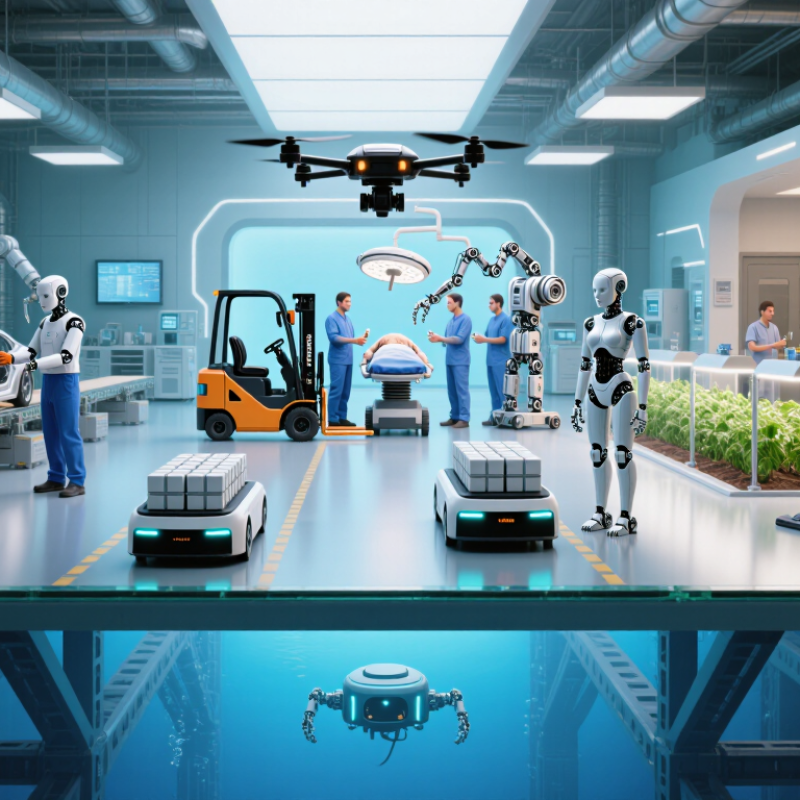
Robotic systems now work in factories, hospitals, warehouses, farms, laboratories, and homes. Their roles differ widely, even when their movements look similar. A six-axis industrial arm may weld a vehicle frame, while a mobile robot carries sealed containers across a warehouse floor. Service robots may guide visitors, clean rooms, or assist with routine inspections.
This guide examines the top 10 types of robotic systems through their design, movement, control methods, and practical uses. It considers industrial robots, collaborative robots, mobile robots, autonomous guided vehicles, humanoid robots, medical robots, agricultural robots, aerial robots, underwater robots, and domestic robots. Each category has different strengths, safety concerns, maintenance needs, and operating limits. A robot that performs perfectly on a smooth factory floor may struggle with a wet ramp, changing lighting, or an unexpected obstacle.
The boundaries are not always clear. Some robots belong to several categories at once. A warehouse platform can be mobile, autonomous, and collaborative. That overlap deserves attention. It prevents simple labels from hiding important engineering details. The discussion draws on established robotics principles, manufacturer documentation, and real-world deployment considerations. It also recognizes an uncomfortable truth: impressive demonstrations do not always predict reliable daily performance. Small failures matter. A delayed sensor reading, loose cable, or poorly planned route can stop an entire workflow. Understanding these ten types requires more than memorizing names. It requires examining where each system works, what it can sense, and where human judgment remains essential.
A robotic system combines mechanical structure, sensors, control software, power, and a defined task. It senses conditions, processes information, and produces movement or force. Classification usually depends on geometry, degrees of freedom, mobility, payload, and working environment. The same machine may fit several categories.
The ten common types include articulated, SCARA, delta, Cartesian, cylindrical, polar, gantry, collaborative, mobile, and humanoid robots. Articulated systems use rotating joints, much like a human arm. SCARA systems perform fast horizontal assembly. Delta robots use parallel arms for lightweight sorting. Cartesian and gantry robots move along straight axes. Cylindrical robots work around a central column. Polar robots reach through rotating and extending joints. Mobile robots travel across floors or uneven ground. Collaborative robots are designed for monitored human interaction. Humanoid systems imitate human movement and body proportions.
Classification becomes more useful when engineers examine the complete system, not only its arm. A mobile robot may include a robotic manipulator, cameras, mapping sensors, and safety controls. A collaborative system also requires speed limits, force monitoring, and carefully tested stopping behavior. Those details shape real performance.
In practice, these categories overlap. A gantry robot can carry a collaborative tool. A mobile platform can operate as a warehouse manipulator. That boundary is not always clean. Experts should compare reach, repeatability, sensing quality, maintenance access, and failure responses before selecting a type. A visually impressive robot may still be unsuitable for a dusty floor, narrow aisle, or changing workload.
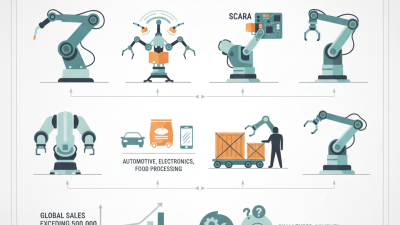
Among the ten major robotic systems, five industrial designs appear repeatedly: articulated, SCARA, Cartesian, cylindrical, and Delta robots. Each solves a different movement problem on the factory floor.
Articulated robots use several rotary joints, often providing four to six axes. They can reach around fixtures, weld curved parts, or handle pallets from changing angles. Their flexibility is impressive, but programming and maintenance require skilled technicians.
SCARA robots move quickly across a horizontal workspace. They suit electronic assembly, screwdriving, and small pick-and-place tasks. Their vertical motion is limited, yet their repeatability remains valuable.
Cartesian robots travel along straight X, Y, and Z axes. Imagine a rigid frame carrying a tool over a worktable. They are simple to calculate and easy to integrate, especially for dispensing or machining.
Cylindrical robots combine rotary movement with vertical and radial travel. They can serve compact work cells, although their reach may feel restricted near obstacles.
Delta robots use lightweight parallel arms above a conveyor. They excel at rapid sorting and packaging, but payload and workspace shape demand careful checking.
Tips: Measure the real work envelope, not just the catalog range. Check payload, cycle time, tooling weight, and cable routing together. A faster robot may still lose productivity when changeovers are frequent. My initial choice is sometimes wrong after observing operator access and cleaning needs. Test the complete cell before committing.
Mobile robots bring robotic systems into changing physical environments. Wheeled robots move efficiently across warehouses, hospitals, farms, and paved streets. Their batteries last longer on smooth floors, but loose gravel can reduce traction quickly. I have seen a small wheel lose contact after crossing a shallow cable channel. The problem looked minor. It stopped the mission.
Legged robots handle stairs, uneven ground, and narrow paths more naturally. Their legs can step over pipes or damaged flooring. However, balance control requires careful sensing and fast correction. A wet surface may still cause a fall. This technology is capable, but not magically reliable. Designers should test it under poor lighting, dust, and sudden obstacles.
Aerial robots provide rapid views of roofs, fields, and emergency areas. They can map a site within minutes, although wind, battery limits, and restricted visibility affect performance. Autonomous underwater systems work differently. They inspect submerged structures, record water conditions, and travel where radio signals cannot reach. Their navigation depends on sonar, depth sensors, and stored maps. Murky water creates uncertainty. Even accurate systems may drift several meters.
Each mobile design reflects a practical trade-off between speed, stability, endurance, and sensing. Human supervision remains valuable, especially when conditions change without warning. More autonomy is useful, yet it should not replace honest testing. Real environments are less cooperative than demonstrations.
The chart compares representative operating-speed ranges for four major mobile robotic system types. Wheeled robots are generally efficient on prepared surfaces, legged robots handle uneven terrain, aerial robots provide high-speed three-dimensional mobility, and autonomous underwater systems prioritize stable movement and energy efficiency in water.
What Are the Top 10 Types of Robotic Systems?
Robotic systems now support work, care, learning, and daily routines. Industrial robots handle welding, assembly, and repetitive production tasks. Collaborative robots work beside people, using sensors to reduce contact risks. They still need careful setup. Service robots may deliver supplies, clean floors, or guide visitors through public buildings. Mobile logistics robots move containers across warehouses, but crowded spaces can challenge their navigation.
Medical robots assist with precise procedures, imaging, and controlled instrument movement. Surgical systems do not replace clinical judgment. Rehabilitation robots help patients repeat walking or grasping exercises with measured resistance. Agricultural robots inspect crops, remove weeds, and collect field data. Educational robots encourage programming and problem-solving through physical experiments. Social robots can provide reminders or simple conversation, especially in care environments. Their emotional understanding remains limited.
Humanoid robots combine cameras, speech systems, hands, and balance control. They may carry objects, greet guests, or practice household assistance. Useful, but not magical. A robot can misread a quiet room, slippery floor, or person’s hesitation. Human supervision remains important in medical and care settings. Reliable deployment requires testing, maintenance records, privacy protection, and clear emergency procedures. Experience shows that simple tasks often create better results than ambitious promises. Some systems still struggle with ordinary doors.
Among industrial, mobile, aerial, medical, underwater, collaborative, humanoid, autonomous, educational, and swarm systems, swarm robotics has a distinct advantage. It uses many simple robots instead of one complex machine. Each unit follows local rules, shares limited information, and reacts to nearby conditions. Together, these small decisions can produce coordinated movement.
In field trials, swarm robots can map damaged buildings, monitor crops, or search wide areas after natural disasters. A robot may detect heat, dust, or an obstacle. Nearby units then adjust their paths without waiting for a central controller. This structure improves resilience because one failed unit does not stop the entire group. However, coordination is not effortless. Communication delays, uneven battery levels, and crowded spaces can create confusion. I have found that simple rules often perform better than ambitious ones, though this view deserves more testing.
Effective swarm design requires measurable goals, safety boundaries, and repeatable experiments. Engineers should compare energy use, coverage, response time, and recovery after failures. Simulation helps, but physical testing reveals uncomfortable details, such as wheel slippage or weak wireless signals. A well-designed swarm is not merely a collection of robots. It is a living coordination problem, and its results may remain partly unpredictable.