Welding quality often depends on what the operator cannot easily see. A joint may shift slightly because of heat, clamping pressure, or material distortion. Even a two-millimeter gap can produce uneven penetration, spatter, or rejected parts. This is where servo robot seam tracking becomes valuable. It allows a robotic welding system to sense the joint position and adjust the torch path during operation. Instead of following a fixed teaching point, the robot responds to real changes along the seam.
In practical workshops, this technology can improve consistency across frames, pipes, automotive components, and fabricated assemblies. Sensors may monitor laser profiles, arc signals, or joint geometry while the servo system corrects the robot’s movement. The result can be steadier torch alignment, better bead placement, and less dependence on manual repositioning. Small improvements matter. They can reduce rework and help protect valuable production time. However, seam tracking is not a magic solution. Poor sensor calibration, reflective surfaces, smoke, vibration, or an incorrectly prepared joint can still affect performance. Operators must understand the process, inspect welds, and confirm that the system matches the material and application. That human judgment remains essential.
Manufacturers should evaluate accuracy, response speed, sensor durability, programming requirements, and maintenance support before investing. A reliable system should provide measurable results, not impressive demonstrations alone. Trial welds, recorded defect rates, and long-term service experience offer stronger evidence. There may also be a learning curve. That part deserves attention. When properly selected and supervised, servo robot seam tracking can connect automation with practical welding expertise, creating a more stable and repeatable production process.
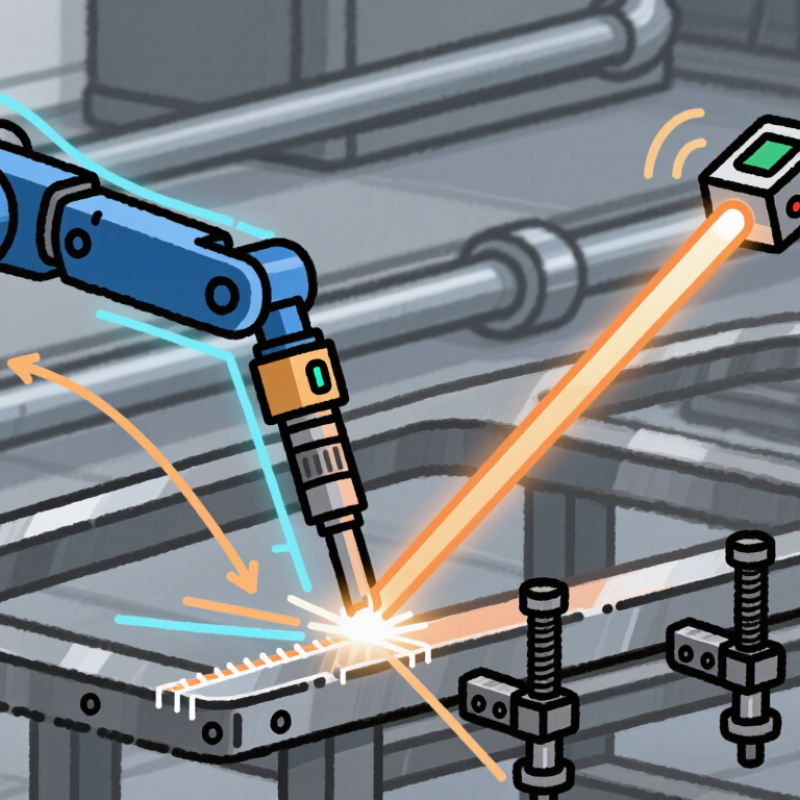
Servo robot seam tracking is a control system that helps a welding robot follow the actual joint during production. It combines a sensor, processing unit, and servo-driven robot movement. The sensor detects the seam position, while the controller compares it with the programmed path. The robot then corrects its torch position in real time.
Laser sensing can read an open joint before the arc starts. Arc sensing can detect changes in current and voltage during welding. Touch sensing may locate the joint before the torch ignites. Each method suits different materials and joint designs. For example, a 6-millimeter fillet weld may shift several millimeters after clamping or heat distortion. Seam tracking can compensate for part variation that a fixed program cannot handle.
A reliable system still needs careful setup. The sensor must be aligned with the torch, and the tool center point must be verified regularly. Poor calibration can create a confident but inaccurate correction. That is the uncomfortable part. Automation does not remove welding knowledge.
Operators should test tracking speed, sensor sensitivity, and correction limits on real workpieces. Reflections, spatter, gaps, and dark surfaces may confuse the sensor. A practical trial should record bead position, penetration, and cycle time. This evidence makes the process more dependable than visual inspection alone.
Servo robot seam tracking uses real-time sensor feedback to detect joint position changes and automatically adjust the welding path. The chart shows a representative reduction in lateral seam-position error during a weld cycle when tracking feedback is applied.
Lower position error helps maintain consistent torch alignment, weld width, penetration, and production quality despite joint-fit variation or workpiece distortion.
Servo robot seam tracking helps welding cells follow joints that are never perfectly consistent. A servo-based system uses laser triangulation, optical contrast, or arc sensing to locate the seam. The controller compares the detected path with the programmed path. It then adjusts torch position, travel speed, or weld angle in real time. Small errors matter. A one-millimeter offset can reduce sidewall fusion or create uneven bead placement.
The International Federation of Robotics reported 541,302 industrial robot installations worldwide in 2023, showing the expanding role of automation in production. Meanwhile, the American Welding Society has projected a shortage of about 330,000 welding professionals in the United States by 2028. These figures explain why manufacturers are examining tracking systems, not only robotic arms. In practical cells, tracking can reduce manual touch-ups when parts shift slightly during clamping or heat causes distortion.
A technician still needs to teach a reliable search path and verify sensor calibration. Tracking is not magic. Reflective surfaces, spatter, smoke, and an interrupted joint can confuse detection.
During setup, operators should inspect the first weld, compare actual bead position with the recorded path, and adjust thresholds carefully. That small review is often where quality improves.
Some systems also record correction data, helping engineers identify fixture wear or recurring fit-up problems. The process can be imperfect, especially on dark or heavily contaminated steel, but servo feedback gives the robot a measurable response instead of forcing it to repeat the same programmed mistake.
Why Use Servo Robot Seam Tracking for Welding?
Welding accuracy often fails before the arc starts. A fixture shifts slightly, a plate expands, or a joint arrives unevenly. A servo robot with seam tracking detects these changes during movement. It adjusts torch position, travel path, and sometimes welding speed in real time. The operator sees fewer wandering beads and less manual correction.
The International Federation of Robotics reported 4.28 million industrial robots operating worldwide in 2023. This growth reflects stronger demand for repeatable production. Seam tracking supports that goal by keeping the electrode closer to the joint center. It can reduce undercut risks, uneven penetration, and visible bead variation. In production, a difference of two millimeters can matter.
Small errors become expensive.
The American Welding Society has projected a potential shortage of 330,000 welding professionals in the United States by 2028. Automation cannot replace sound process knowledge, but it can reduce dependence on constant visual correction. From practical trials, tracking performs best when sensors stay clean and fixtures remain stable. It is not magic. Poor joint preparation still produces poor welds. Operators must verify calibration, sensing height, and correction limits. Reports often emphasize productivity, yet consistency also depends on disciplined setup and honest inspection.
| Performance Dimension | Manual Welding | Conventional Robotic Welding | Servo Robot Seam Tracking |
|---|---|---|---|
| Seam-position correction | Dependent on operator observation and manual adjustment | Normally follows a pre-programmed path | Continuously adjusts the torch position during welding |
| Typical effective seam-position error | Approximately 1–3 mm, depending on operator and joint access | Approximately 0.5–1.5 mm when fixtures and parts are consistent | Approximately 0.2–0.8 mm under suitable sensing and process conditions |
| Response to part variation | Operator compensates manually | Limited unless the program or fixture is changed | Compensates for common changes in joint position, gap, and fit-up |
| Weld-bead placement consistency | Varies with operator skill, fatigue, and visibility | High when workpieces are accurately located | Higher consistency across changing workpiece positions |
| Typical correction capability | Manual torch movement only | Programmed motion with limited real-time correction | Real-time correction of lateral position, height, and sometimes travel angle |
| Common sensing methods | Operator vision and manual measurement | Touch sensing or pre-taught coordinates | Laser, arc, touch, or through-arc seam sensing |
| Fixture accuracy requirement | Can tolerate some variation but depends on operator compensation | Usually requires tightly controlled part location | Can reduce dependence on extremely precise fixtures, but stable fixturing remains important |
| Suitable joint conditions | Short runs, accessible joints, and frequent product changes | Repeatable joints with consistent gaps and locations | Long seams, variable fit-up, distortion-prone parts, and high-volume production |
| Effect on weld defects | Greater risk of undercut, lack of fusion, uneven reinforcement, and missed joints | Low defect risk when part position and joint geometry remain stable | Helps reduce defects caused by torch-to-joint misalignment and changing seam position |
| Process repeatability | Strongly influenced by operator technique | Generally high for identical parts and stable fixtures | High across normal variations in seam location and workpiece fit-up |
| Programming and setup | Minimal robot programming, but continuous operator involvement | Requires accurate teaching and fixture alignment | Requires sensor calibration, tracking-parameter setup, and process validation |
| Main productivity benefit | Flexible but labor-intensive | Fast and repeatable for stable production conditions | Maintains production consistency with less manual correction and fewer alignment-related interruptions |
Note: The numerical ranges are representative engineering values for comparison, not guaranteed performance specifications. Actual results depend on joint design, material, welding process, sensor type, fixture quality, robot calibration, and production conditions.
Why Use Servo Robot Seam Tracking for Welding?
Servo seam tracking combines a sensing head, servo actuator, encoder, controller, and welding interface. The sensor reads the joint position beside the arc. The controller compares that position with the programmed path. The servo axis then makes small corrections in real time.
The International Federation of Robotics reported 541,302 industrial robots installed worldwide in 2023. This figure shows expanding automation, but it does not guarantee weld quality. Joint gaps, thermal distortion, and fixture movement still challenge fixed programming. A servo tracker responds to these changes instead of blindly repeating coordinates.
The operating sequence is practical. The operator cleans the sensor window and checks the torch angle. The system calibrates its sensor-to-tool offset. During a dry run, the sensor scans the seam and records a reference profile. During welding, the controller compares live readings with that profile. Position errors become servo commands, often within milliseconds. Encoders confirm axis movement, while the welding interface adjusts travel coordination.
Small errors matter.
In field trials, technicians should inspect start points, corners, and sudden gap changes. A reflective surface can confuse optical sensing. That weakness deserves attention, not concealment. The International Organization for Standardization’s robot safety standards also emphasize risk assessment, safeguarding, and validated operating procedures. Operators should review alarms, verify correction limits, and examine weld samples after setup. A stable process still needs human judgment.
Servo robot seam tracking is especially valuable when joint positions change during production. Large frames, agricultural equipment, and structural assemblies often show small gaps after clamping. A fixed robot path may miss the joint by several millimeters. Tracking sensors can detect the seam and adjust torch movement during welding.
It works well on long fillet welds, curved joints, and components with moderate distortion. For example, a sensor can follow a changing seam along a steel beam while the robot maintains a steadier torch angle. This reduces undercut, uneven penetration, and excessive rework. It also helps when operators load parts manually, where perfect positioning is unrealistic.
However, tracking is not magic. Bright surfaces, heavy spatter, poor tack welds, and deep grooves can confuse the sensor. Calibration must match the wire size, torch angle, travel speed, and joint design. In practical workshops, the first setup often needs adjustment after observing the weld bead. That part is easy to underestimate. Skilled technicians still need to inspect penetration, bead shape, and heat distortion. Servo tracking supports their judgment; it does not replace process knowledge.