How to Choose a Dispensing Robot in 2026?
Choosing a dispensing robot in 2026 means matching the system to your process, not chasing the longest feature list. Start with the material: its viscosity, curing behavior, and sensitivity to temperature can affect flow and repeatability. Then consider the task itself. A small bead on a flat panel needs different motion and tooling from a precise dot inside a deep housing. Useful questions include: Can the robot reach every target? How easily can operators adjust the path? Does the controller connect with existing production equipment?
A showroom demo can look smooth. Your own material may behave differently. Ask suppliers to test representative parts, using your actual fluid, nozzle, and production settings where possible. Review bead consistency, cycle time, changeover steps, and how the system handles pauses or restart. Also check routine details: fixture access, cleaning time, spare-part availability, training, and local technical support. These can matter more than a headline speed figure.
There is no universal best choice. A system suited to high-volume assembly may be unnecessarily complex for frequent product changes. Compare the full operating cost, and confirm which performance claims are measured under conditions like yours. Keep a record of test results and acceptance criteria before purchasing. One limitation may remain: early trials cannot capture every production variation. That is worth admitting. A careful selection process helps teams choose a dispensing robot that fits real work, while leaving room to review performance after installation.
Define the Dispensing Task, Materials, and Production Requirements
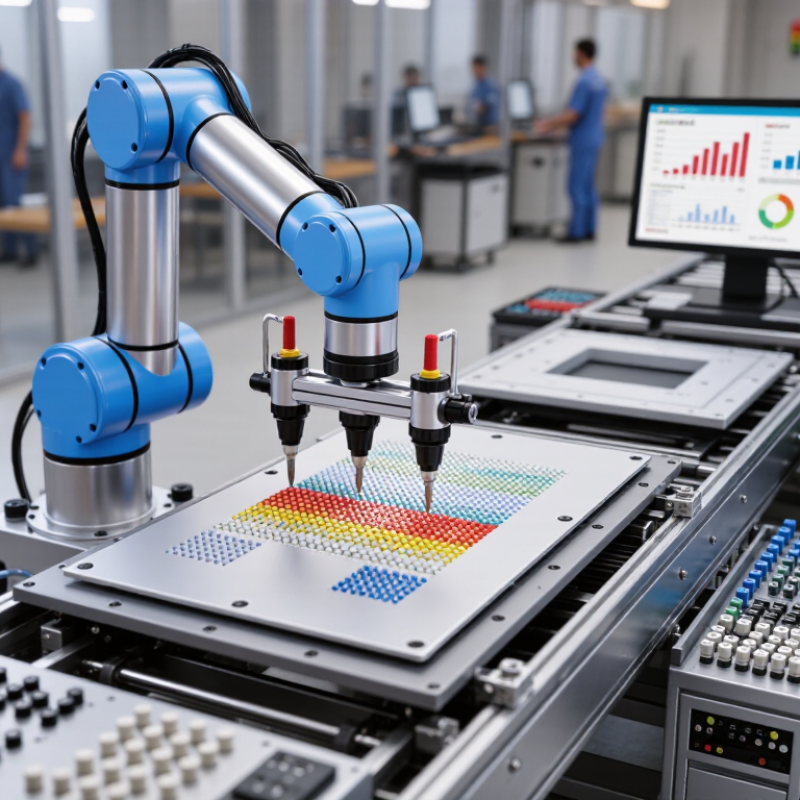
Choosing a dispensing robot begins with the job, not the machine. Define whether it must place small dots, draw continuous beads, fill cavities, or coat a surface. Each task needs different motion control and fluid delivery. Specify bead width, volume, path length, and acceptable variation. Small details matter. A 0.5-millimeter shift may be harmless on a wide panel but costly near a narrow seal.
Describe the actual material, including viscosity, fillers, temperature sensitivity, and curing time. A thick adhesive with abrasive particles behaves differently from a low-viscosity coating. Note how it flows after dispensing and whether it strings when the nozzle lifts. Test the real material. Use representative parts, not just a smooth sample plate; surface texture can change wetting. A neat test bead can still mislead.
Production needs shape the choice too. Record target cycle time, daily operating hours, changeover frequency, and available floor space. Check whether the robot can reach every dispense point without awkward repositioning. Consider material replenishment, cleaning access, and operator training. Measure repeatability over many cycles, then inspect parts after a full shift. A short trial may miss drift or clogging. I would not treat one successful run as proof; collecting better data takes time, but it makes the selection more dependable.
Set Precision, Speed, and Repeatability Targets
How to Choose a Dispensing Robot in 2026?
Set Precision, Speed, and Repeatability Targets
Set targets around the finished bead, not a machine’s headline specifications. Measure bead width, start-and-stop position, and material volume on your actual parts. Include corners, narrow gaps, and changes in surface height. Small differences matter. A 0.2-millimeter placement error may be acceptable on a broad seal, but costly beside a delicate component. Define acceptable limits before comparing systems.
ISO 9283 describes methods for assessing industrial robot performance, including pose and path repeatability. Use those measures as a testing framework, not a promise of dispensing quality. The International Federation of Robotics reported 4,281,585 industrial robots operating worldwide at the end of 2023 in World Robotics 2024. That figure signals broad industrial adoption; it is not a dispensing-specific performance benchmark. Test the complete cell, including the tool, fixture, material, and motion program.
Set cycle-time targets using the required bead length and real production schedule. Then run repeated trials with the intended material, temperature, and nozzle. Record variation between shots, not only the best result. Test it warm. Viscosity shifts, pauses, and nozzle wear can change flow, even when robot motion repeats closely. A practical acceptance test might require 30 consecutive parts within your bead-width and placement limits. The number is only a starting point; your process may need more trials, especially if failures are expensive.
How to Choose a Dispensing Robot in 2026: Set Precision, Speed, and Repeatability Targets
Example cycle-time acceptance targets by dispensing task. These are planning benchmarks, not measured performance or universal specifications.
Use the cycle-time limits as starting points: ≤2.0 seconds per dispense cycle for fine beads, ≤1.0 second for general assembly, and ≤0.5 seconds for high-throughput work. Pair them with application-specific acceptance limits—for example, TCP repeatability of ≤0.02 mm, ≤0.05 mm, and ≤0.10 mm respectively, and shot-mass coefficient of variation (CV) of ≤2%, ≤3%, and ≤5%. Repeatability measures consistency, not absolute accuracy. Validate all targets using the actual material, nozzle, path, and production conditions.
Match Robot Type and Configuration to the Application
How to Choose a Dispensing Robot in 2026?
Match the robot to the bead, the part, and the production rhythm. A Cartesian system suits straight, repeatable paths across flat panels or trays. For compact parts with changing angles, a six-axis arm can reach around edges and recesses. A SCARA system may fit fast, planar work, but its reach and approach angle need checking. The International Federation of Robotics’ World Robotics 2024 report counted 4,281,585 industrial robots operating worldwide in 2023. That figure shows automation’s scale, not which robot will dispense best. Application details decide that.
Start with the material. A thin, steady adhesive may need a different pump and valve than a viscous sealant that pauses between shots. Record bead width, flow rate, path length, corner behavior, and cure time using the actual material. Then test the robot’s reach, payload, repeatability, and required cycle time with real parts. That matters. A neat specification sheet can still mislead: a fast arm may struggle with a slow, pressure-sensitive dispense. Configuration matters too. Choose fixtures, vision, and part sensing only where they correct a known variation. The IFR report is useful context, but it does not replace a dispensing trial. Sometimes the awkward corner tells you more than the brochure.
Check Software, Integration, Safety, and Maintenance Needs
How to Choose a Dispensing Robot in 2026?
Check software, integration, safety, and maintenance before comparing speed or price. The International Federation of Robotics reported 4,281,585 industrial robots operating worldwide in 2023 in World Robotics 2024. That scale makes interoperability worth checking: ask whether the controller can exchange job data with your production system and save traceable records for each dispense cycle. Test a real bead pattern, not just a screen demo. Can operators adjust flow, speed, and path without editing code? Software can look simple until recipes change mid-shift.
Integration is physical, too. Check reach, payload, fixture access, and the time needed to switch a syringe or nozzle. For safety, review the risk assessment, guarding, emergency stops, and safe access during cleaning, using applicable robot safety standards such as ISO 10218 as a reference. Maintenance needs deserve equal attention: confirm calibration intervals, spare-part availability, nozzle-change procedures, and whether fault logs help technicians find the cause of uneven flow. One thing I would question: a polished uptime estimate means little without its assumptions.
Tips: Run a sample part with your actual material. Ask maintenance staff to perform a nozzle change and recovery from a simulated fault. Record the time and steps. Small gaps show up fast.
Compare Suppliers and Validate the System Before Purchase
How to Choose a Dispensing Robot in 2026?
Compare Suppliers and Validate the System Before Purchase
Compare suppliers using the same material, nozzle, path, and cycle-time target. Ask for written data on repeatability, bead width, changeover time, and service response. Request a trial with your actual adhesive or sealant, not a substitute with easier flow. Test it wet. Inspect starts, corners, pauses, and the final cutoff under consistent lighting. A neat demo can still mislead. IFR’s World Robotics 2024 report recorded 541,302 industrial robot installations in 2023, following 553,052 in 2022, reported in World Robotics 2023. Those figures describe industrial robots overall, not dispensing systems, but they underline why supplier support and integration experience deserve careful comparison.
Before purchase, agree on measurable acceptance criteria with each supplier. Run repeated cycles, then check bead placement and mass across the first and last parts. Include realistic shifts, operator handoffs, and planned cleaning; small setup differences can change results. Record failed cycles too. Ask who owns recipe changes, what spare parts are stocked, and how quickly remote or onsite support is available. Compare the full cost of fixtures, programming, training, and maintenance, not just the robot quote. I would keep one question open: will the process remain stable with next year’s material batch? Test that if possible. A short pilot may expose issues a polished factory demonstration misses.